What is Focal Length? A Guide for Choosing the Right Lens
The first time I stood in a camera store trying to buy a lens, I felt completely out of my depth. I was staring at a wall of options, 18-55mm, 50mm, 70-200mm, and I genuinely had no idea what any of those numbers meant or which one I actually needed. I ended up asking the guy behind the counter, "Does it matter? Isn't a lens just a lens?" He laughed, kindly, and spent the next twenty minutes changing how I thought about photography entirely.
Focal length is one of those topics that sounds technical and intimidating, but once it clicks, it becomes one of the most useful pieces of knowledge you'll ever have as a photographer, right up there with understanding the exposure triangle. It's the difference between grabbing a lens at random and choosing the right tool on purpose for what you're actually trying to capture.
What Focal Length Actually Means
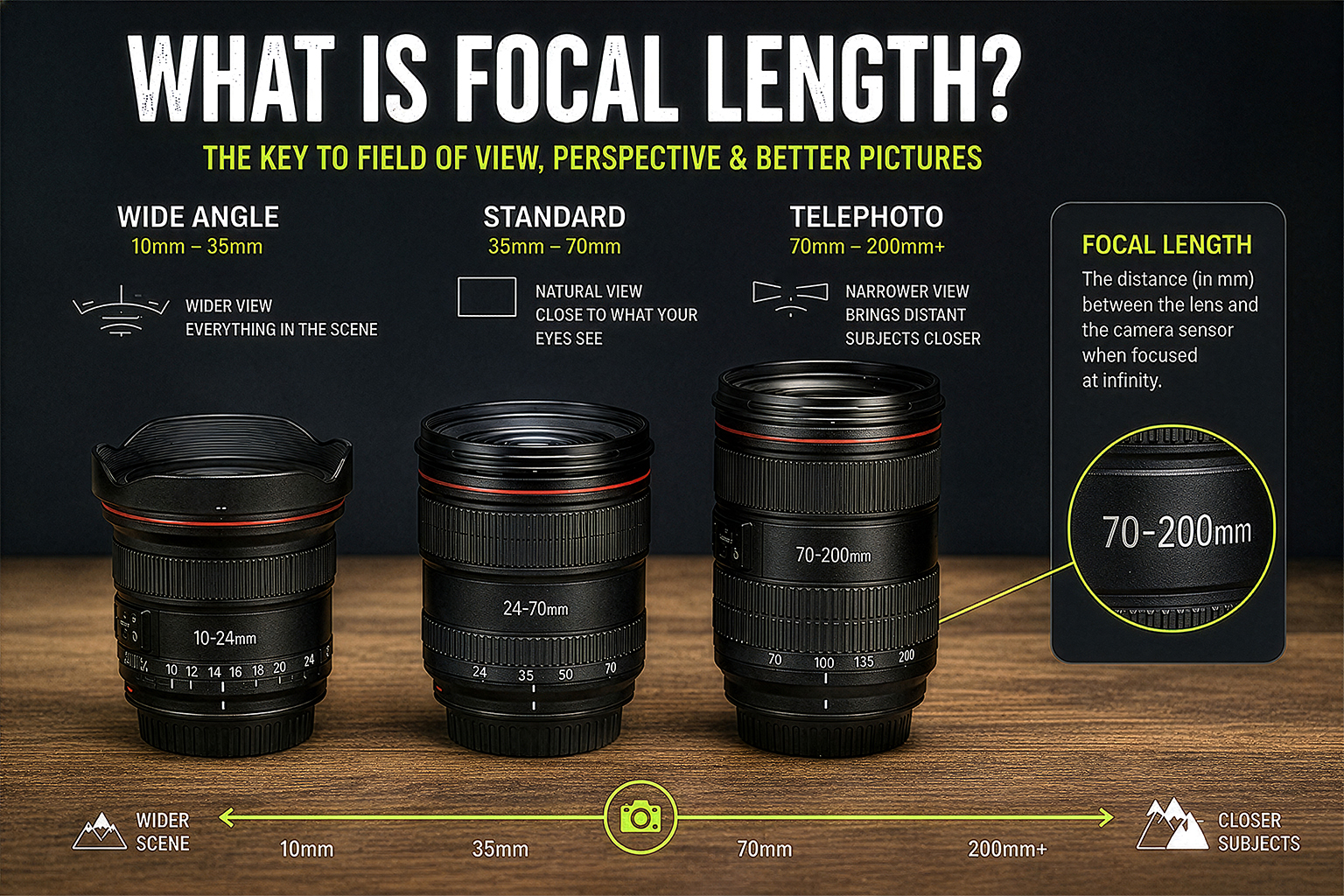
Focal length is measured in millimetres, and it describes the distance between the optical center of your lens and your camera's sensor when the lens is focused at infinity. I know that definition doesn't mean much on its own, so here's the version that actually matters day to day: focal length determines two things, how much of a scene your lens can see, and how much it magnifies what's far away.
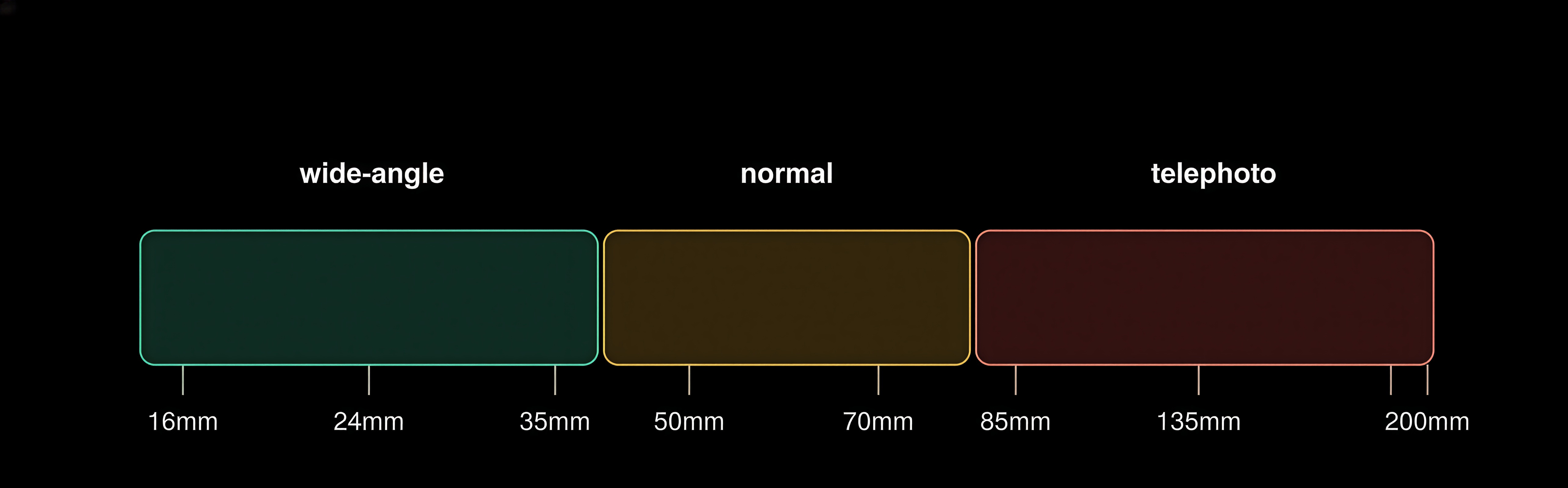 A short focal length, like 18mm, has a wide field of view. It sees a lot of the scene in front of you, which is why these are called wide-angle lenses. A long focal length, like 200mm, has a narrow field of view but magnifies distant subjects, which is why these are called telephoto lenses. Anything in between, roughly 35mm to 70mm, is often called a "normal" focal length, because it sees the world in a way that feels close to how our own eyes perceive it.
Wide-Angle Lenses (Under 35mm)
Wide-angle lenses capture a broad field of view, which makes them the go-to choice for landscapes, architecture, and interiors, basically anything where you want to fit a lot into the frame. Stand in a small room and try photographing the whole space with a 50mm lens, and you'll quickly see the problem, you simply can't back up far enough to fit it all in. Switch to something like 16mm or 24mm, and suddenly the whole room fits.

Wide lenses also introduce a bit of exaggerated perspective, foreground objects appear larger and more dramatic, while background objects shrink away. Landscape photographers use this constantly, placing an interesting rock or flower close to the lens in the foreground, with a mountain range stretching out behind it.
The trade-off is that wide-angle lenses aren't very flattering for close-up portraits. Get too close to someone's face with a wide lens and you'll distort their features in ways that generally aren't very kind.
Normal Lenses (35mm to 70mm)
This range is often considered the most versatile, and it's where a lot of photographers end up living most of the time. A 50mm lens in particular has earned a reputation as the classic "nifty fifty," beloved for how naturally it renders a scene, without the exaggeration of a wide lens or the compression of a telephoto.
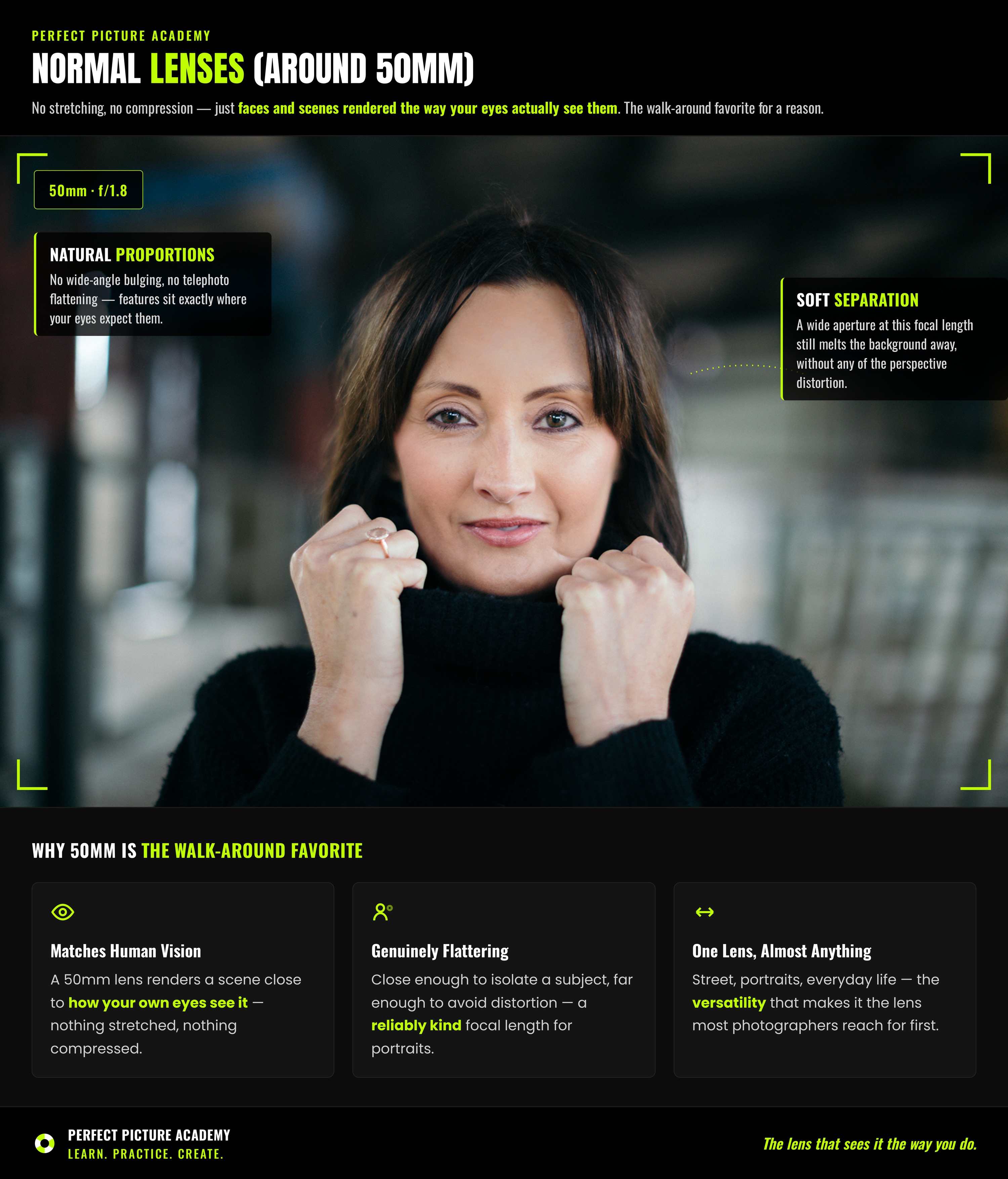
This range works beautifully for portraits, street photography, everyday documentary-style shots, and general walk-around shooting. If you only ever owned one lens for the rest of your life, something in this range would serve you well across the widest variety of situations.
Telephoto Lenses (Over 70mm)
Telephoto lenses reach out and magnify subjects that are far away, which makes them essential for wildlife, sports, and any situation where you physically can't, or shouldn't, get close to your subject. Try photographing a bird on a branch or an athlete mid-play from twenty feet away with a wide-angle lens, and you'll end up with a tiny, disappointing speck in the middle of your frame. A 200mm or 300mm lens fixes that instantly.
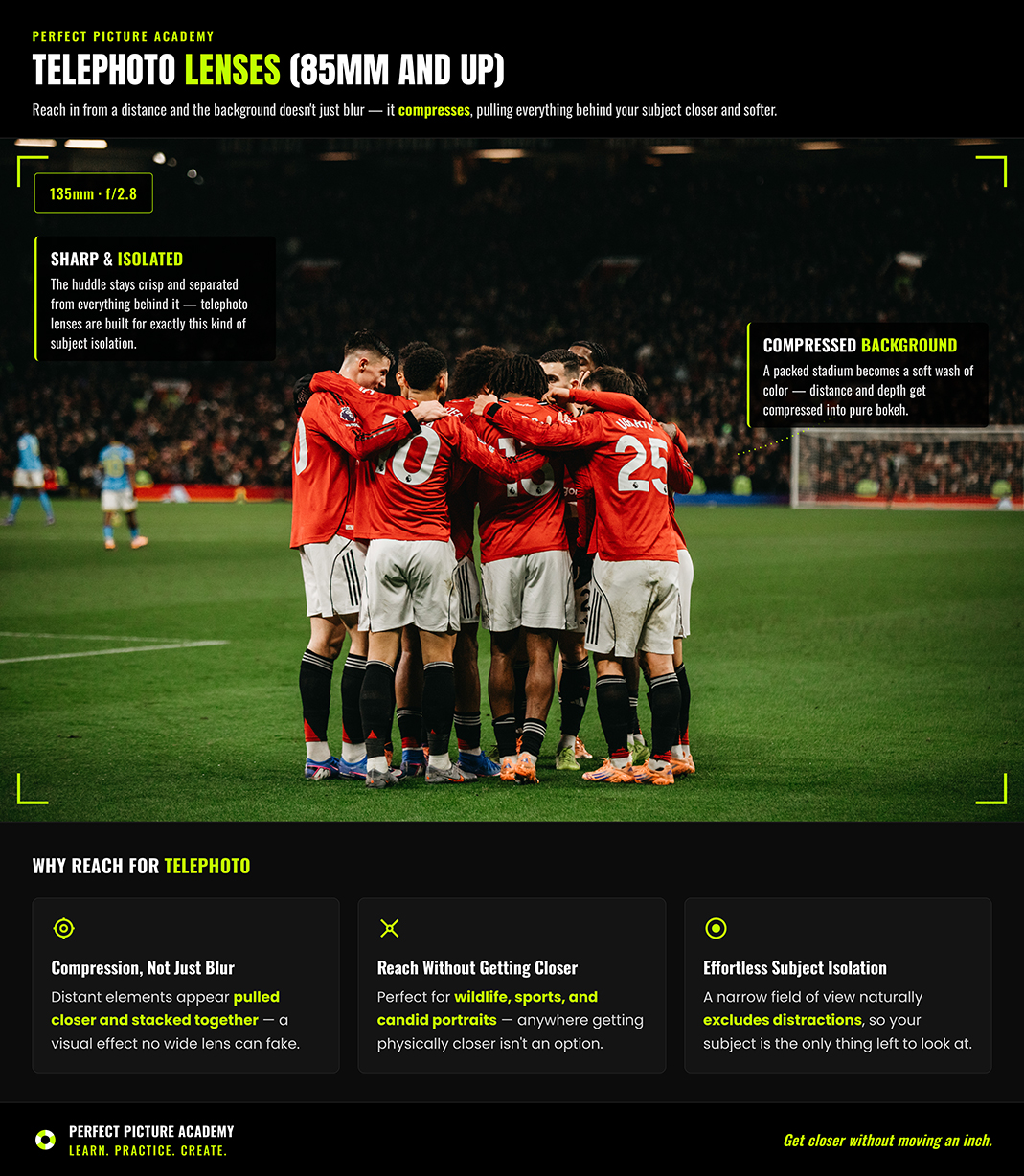
Telephoto lenses also compress the distance between foreground and background elements, making them appear closer together than they really are. This is a favorite trick for portrait photographers too, something in the 85mm to 135mm range creates gorgeous background compression along with that soft, blurred bokeh look, which is why so many classic portrait lenses live in this range.
Prime Lenses vs. Zoom Lenses
There's one more distinction worth understanding here. A prime lens has a single, fixed focal length, like 50mm, with no zooming in or out. A zoom lens covers a range, like 24-70mm, letting you adjust focal length on the fly.
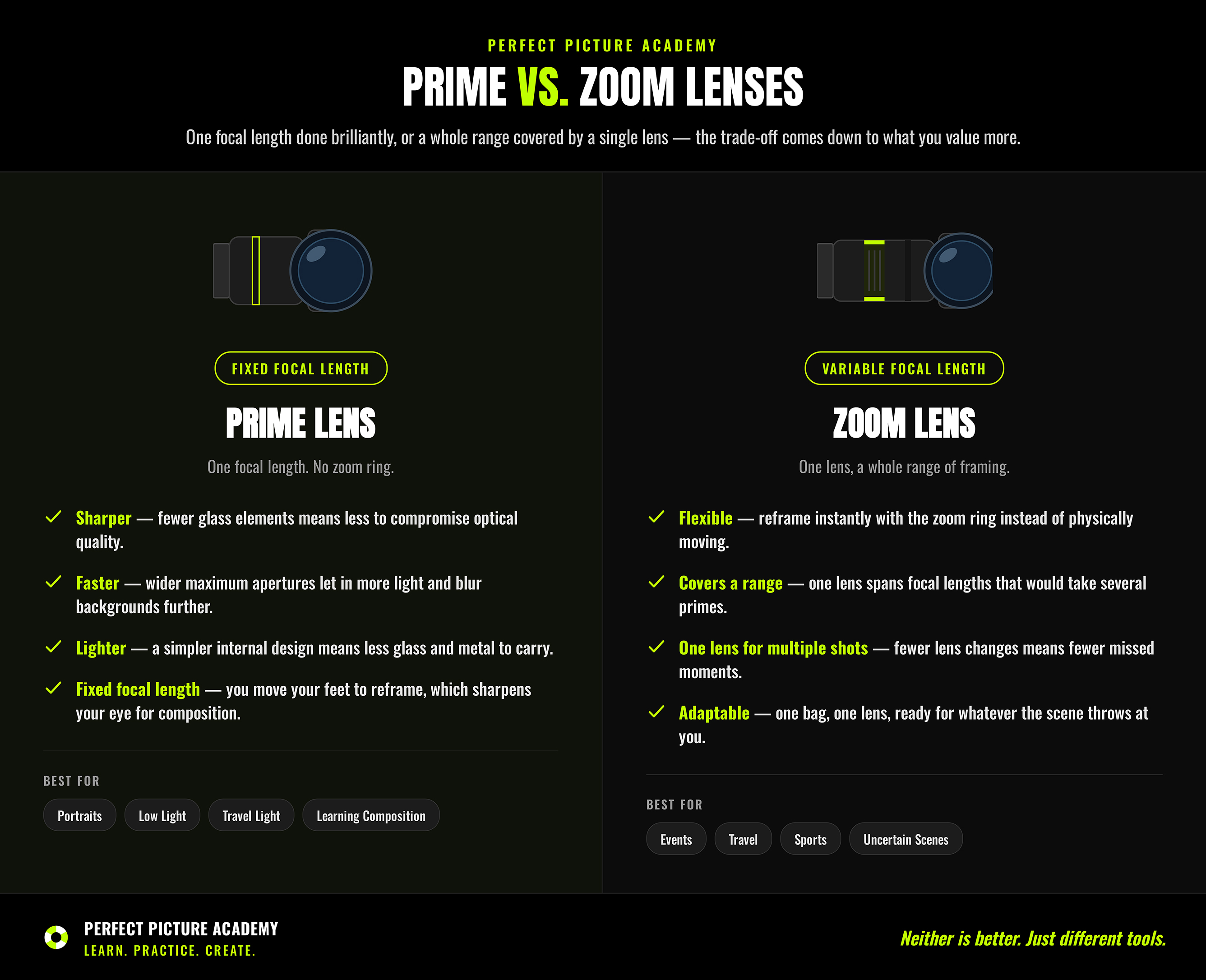
Prime lenses tend to be sharper, faster (meaning they let in more light through a wider maximum aperture), and lighter, but they require you to physically move your feet to reframe a shot instead of just twisting a zoom ring. Zoom lenses trade a bit of that optical perfection for flexibility, letting you cover multiple focal lengths without swapping lenses mid-shoot. Neither is objectively better, it genuinely depends on how you like to shoot.
So Which Lens Should You Actually Buy?
Here's my honest advice, the same advice I wish that guy behind the camera counter had given me years ago. Don't buy a lens based on what's popular or what a YouTuber recommended, buy a lens based on what you actually shoot most often.
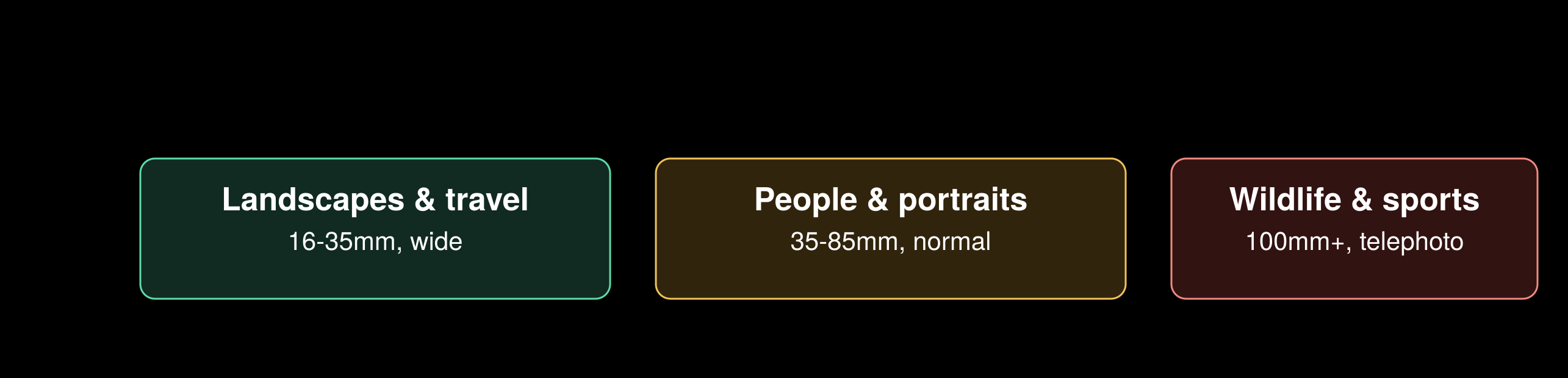
If you're drawn to landscapes and travel, look at something wide, in the 16-35mm range. If you're mostly photographing people, whether that's portraits or everyday family life, a 35mm, 50mm, or 85mm prime is going to serve you beautifully. If you're chasing wildlife, sports, or anything far away and fast-moving, you'll need real reach, something starting around 100mm and going up from there.
And if you're just starting out and genuinely don't know yet, a versatile mid-range zoom, something like a 24-70mm, is a fantastic way to explore a wide variety of focal lengths and figure out what you naturally gravitate toward before committing to specialized glass.
Final Thoughts
Focal length isn't just a technical spec buried in a spreadsheet, it's a creative decision that shapes how your entire picture feels, how much you can fit in frame, how distant subjects are magnified, and even how flattering a portrait looks. Understanding it means you stop reaching for whatever lens happens to be attached to your camera, and start choosing the right tool on purpose, every time.
Ready to take pictures you're proud of?
Start with my free Camera Settings Checklist. It shows you exactly what to check before every shot, so you never miss an important setting again.
When you're ready to go further, Premium teaches you my SIMPLE system step by step, so you can take pictures you're proud of with the camera you already own.
Get Your Free Camera Settings Checklist
Know exactly what to check before every shot, so you never miss an important setting again. Free, straight to your inbox.
No spam, ever. Unsubscribe any time. Our Privacy Policy is linked at the bottom of this page.